Showing posts with label EHS Notes. Show all posts

LIST OF INDIAN STANDARDS ON SAFETY & HEALTH

LIST OF INDIAN STANDARDS ON SAFETY & HEALTH


GENERAL
  • IS 3646 : 1922 Part 1 Code of practice for interior illumination General Requirements and recommendations for welding interiors
  • IS 3646 : 1966 Part 2 Code of practice for interior illumination – Schedule for values of illumination and glare index.
  • IS 3646 : 1968 Part 3 Code of practice for interior illumination – Calculation of coefficients of utilization by the BZ method.
  • IS 3786 : 1983 Methods for computation of frequency and severity rates for industrial injuries and classification of industrial accidents.
  • IS 5182  : Part 1 to 21 Methods for measurement of Air Pollution
  • IS 8095 : 1976 Specification for Accident Prevention Tags
  • IS 8990 : 1978  Code of practice for maintenance and care of industrial safety clothing.
  • IS 9457 : 1980 Safety colours and safety signs
  • IS 11972 : 1987 Code of practice for safety precautions to be taken when entering a sewerage system.
  • IS 14489 : 1998 Code of practice on occupational safety and health audit.
  • IS 14624 : 1998  Part 2 Safety of laser products : Safety of optical fiber communication system
  • IS 15296 : 2003 Industrial Automation systems – Safety of Integrated Manufacturing Systems –Basic Requirements
  • IS 15551 : 2003 Quality Management Systems – Guidelines for Process Improvements in Health Service Organisations
  • IS 18001 : 2000 Occupational Health and Safety Management Systems – Specification with Guidance for use
  • SP 53 : 1992 Hand operated hand tools – Safety code for the use, care and protection
  • IS/ISO/IEC : GUIDE51 Guidelines for the inclusion of safety aspects in Standards 1990

Machinery / Operations
  • IS 659 : 1964 Safety Code for air conditioning (revised)
  • IS 818 : 1968  Code of practice for Safety and Health Requirements in electric and gas welding and cutting operations.
  • IS 1991 : 1988 Part 4 Safety requirements for the use, care and protection of abrasive grinding wheels: Safety guards.
  • IS 2825 : 1969 Code of unfired pressure vessels
  • IS 3233 : 1965 Glossary of terms for safety and relief valves and their parts
  • IS 3483 : 1965 Code of practice for noise reduction in industrial buildings
  • IS 5903 : 1970 Recommendations for safety devices for gas cylinders.
  • IS 6044 : 2000 Part 1 Code of Practice for Liquefied Petroleum Gas Storage Installations – Part 1 : Commercial and Industrial Cylinder Installations
  • IS 7155 : Part 1 to 8 Code of recommended practice for conveyor safety
  • IS 7194 : 1994 Assessment of Noise Exposure during work for hearing conservation purpose
  • IS 8089 : 1976 Code of safe practice for layout of outside facilities in an industrial plant 
  • IS 8091 : 1976 Code of safe practice for industrial plant layout
  • IS 8216 : 1976 Guide for inspection of lift wire ropes
  • IS 8235 : 1976 Guide for safety procedures in hand operated hand tools
  • IS 8324 : 1988 Code of practice for safe use and maintenance on non-calibrated round steel link lifting chains and chin slings 
  • IS 8433 : 1984 Code of safe practice for visual inspection of dissolved acetylene gas cylinders 
  • IS 9020 : 2002 Power Threshers – Safety Requirements
  • IS 9474 : 1980 Specification for principles of mechanical guarding of machinery 
  • IS 10553 : 1983 Part 1 Requirements for chlorination equipment : General guidelines for chlorination plants including handling, storage and safety of chlorine cylinders and drums
  • IS 10224 : 1982 Ergonomic principles in the design of work systems
  • IS 11006 : 1984 Specification for flash back arrestor (flame arrestor)
  • IS 11016 : 1984 General safety requirements for machine tools and their operation.
  • IS 11461 : 1985 Code of practice for compressor safety
  • IS 12735 : 1994 Wire rope slings – safety criteria and inspection procedures for use
  • IS 13367 : 1992 Part 1 Safe use of cranes – code of practice - General
  • IS 13583 : 1993 Part 1 Cranes – Training of drivers : General
  • IS 14817 : 2004 Part 2 Mechanical Vibration – Evaluation of machine vibration by measurements on non-rotating parts – large land – based steam turbine generator sets in excess of 50 MW

Avoiding danger from overhead power lines

Avoiding danger from overhead power lines


In this post, we are sharing the entire details about Avoiding danger from overhead power lines through the pdf file. We have given the link below to download the pdf file.

Contents in the pdf
  • Introduction
  • Types of overhead power lines and their heights 
  • What does the law require? 
  • Preventing overhead line contact accidents 
  • Working near overhead lines connected to buildings 
  • Emergency procedures 
  • Industry-specific guidance 
  • Annex 1 The law
  • References 
  • Further information 

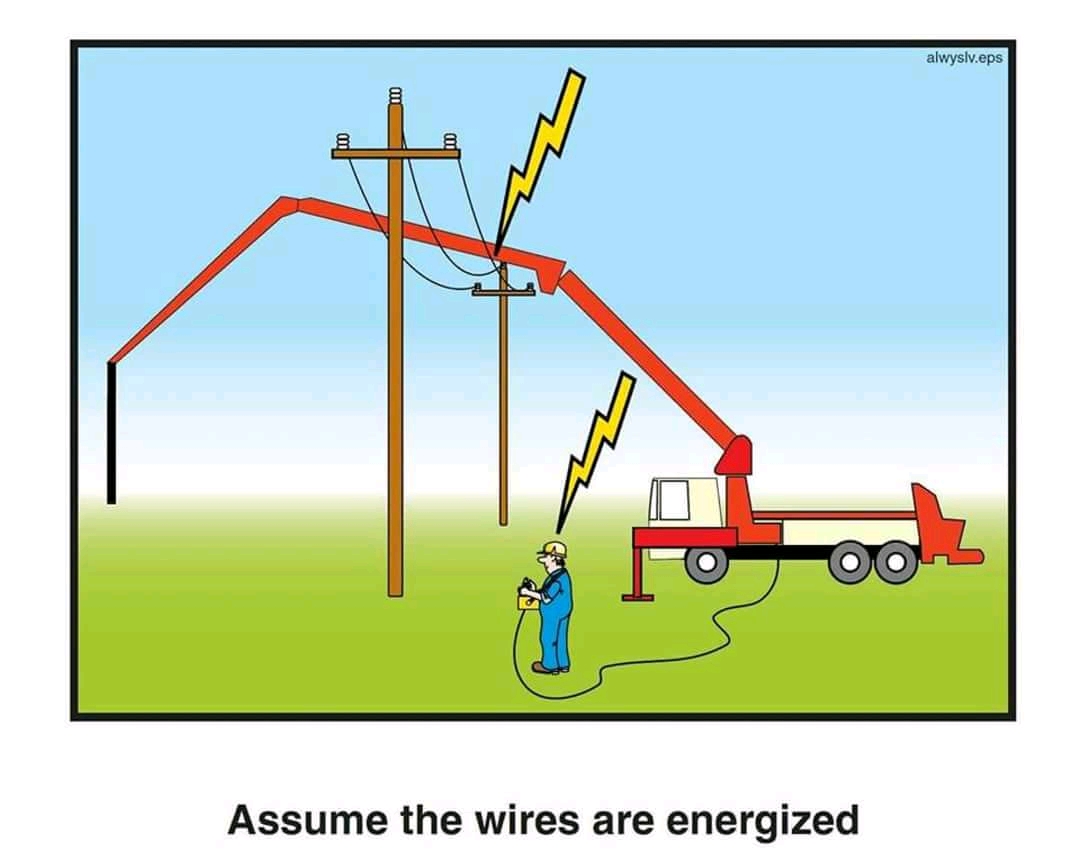
Concrete Boom Pumps: Safety

Concrete Boom Pumps: Safety

In this post, we have uploaded the pictures of Concrete Boom Pumps: Safety.

1) Outrigger

2) Distance 

3) Remove everyone from the discharge area whenever air is in the line


4) Crane Hand Signals


5) Never Boom over wires

6) Blowing out a vertical pipeline


7) Never rely on depth perception with electric wires


8) Do not allow hose to hink

9) Watch out for the pinch points


11) Maintain a clearance of atleast 17 feet from wires. 


12) Don't kink the hose


13) Beware of these outrigger hazards 


14) Never straddle or sit on a pressurized pipeline

15) No lifting with the boom


16) PPE


17) Proper communication


18) Do not exceed the maximum height allowed to hang from the boom


19) Clearing with compressed air can be extremely hazardous if you don't follow the safety rules


20) Maintain a safe distance from obstructions


21) Never stand between the ready mix truck and the pump. Use clear concise hand signals.


22)  Maintain the safe distance from the electrical lines.

OSHA Trenching and Excavation Safety Questions & Answers Part 1 Introduction

OSHA Trenching and Excavation Safety Questions & Answers Part 1 Introduction


1) What is the difference between an excavation and a trench?

OSHA defines an excavation as any man-made cut, cavity, trench, or depression in the Earth’s surface formed by earth removal. A trench is defined as a narrow excavation (in relation to its length) made below the surface of the ground. In general, the depth of a trench is greater than its width, but the width of a trench (measured at the bottom) is not greater than 15 feet (4.6 m).

2) What are the dangers of trenching and excavation operations?

Trenching and excavation work presents serious hazards to all workers involved. Cave-ins pose the greatest risk and are more likely than some other excavation-related incidents to result in worker fatalities. One cubic yard of soil can weigh as much as a car. An unprotected trench can be an early grave. Employers must ensure that workers enter trenches only after adequate protections are in place to address cave-in hazards. Other potential hazards associated with trenching work include falling loads, hazardous atmospheres, and hazards from mobile equipment.

3) What do the OSHA Excavation standards cover, and how do they protect workers?

The standards apply to all open excavations made in the Earth’s surface, including trenches. Following the requirements of the standards will prevent or greatly reduce the risk of cave-ins and other excavation-related incidents.

4) What are the soil classification categories?

Some of the compliance methods permitted under the Excavation standards require a competent person to classify soil and rock deposits as:
  • Stable rock;
  • Type A soil;
  • Type B soil;
  • Type C soil.
5) What is a competent person?

A competent person is an individual, designated by the employer, who is capable of identifying existing and predictable hazards in the surroundings or working conditions which are unsanitary, hazardous or dangerous to workers, and who is authorized to take prompt corrective measures to eliminate them.


Under the Excavation standards, tasks performed by the competent person include:
  • Classifying soil;
  • Inspecting protective systems;
  • Designing structural ramps;
  • Monitoring water removal equipment; and
  • Conducting site inspections.

Ergonomics: Screening for Risk Factors

Ergonomics: Screening for Risk Factors


Screening jobs for physical and psychological risk factors is very proactive, and should involve one or more of the following:
  • Walk-through observational surveys of the work facilities to detect obvious risk factors
  • Interviews with workers and supervisors to obtain the above information and other data not apparent in walk-through observations, such as time and workload pressures, length of rest breaks, etc.
  • Checklists for scoring job features against a list of risk factors

A great deal of research has been conducted to identify workplace factors that contribute to the development of musculoskeletal disorders. NIOSH has recently summarized the epidemiological studies that show a relationship between specific work activities and the development of musculoskeletal disorders.

According to the scientific literature, the following are recognized as important risk factors for musculoskeletal disorders, especially when occurring at high levels and in combination. Physical risk factors include:
  • Awkward postures
  • Forceful exertions
  • Repetitive motions
  • Duration of exposure
  • Frequency of exposure
  • Contact stresses
  • Vibration
  • Other conditions
  • Let's take a closer look at each of these risk factors.
  • Physical Risk factors

Awkward postures

Body postures determine which joints and muscles are used in an activity and the amount of force or stresses that are generated or tolerated. For example, more stress is placed on the spinal discs when lifting, lowering, or handling objects with the back bent or twisted, compared with when the back is straight. Manipulative or other tasks requiring repeated or sustained bending or twisting of the wrists, knees, hips, or shoulders also impose increased stresses on these joints. Activities requiring frequent or prolonged work over shoulder height can be particularly stressful.

Forceful exertions (including lifting, pushing, and pulling)

Tasks that require forceful exertions place higher loads on the muscles, tendons, ligaments, and joints. Increasing force means increasing body demands such as greater muscle exertion along with other physiological changes necessary to sustain an increased effort. Prolonged or recurrent experiences of this type can give rise to not only feelings of fatigue but may also lead to musculoskeletal problems when there is inadequate time for rest or recovery. Force requirements may increase with:
  • increased weight of a load handled or lifted
  • increased bulkiness of the load handled or lifted
  • use of an awkward posture
  • the speeding up of movements, increased slipperiness of the objects handled (requiring increased grip force)
  • the presence of vibration (e.g., localized vibration from power handtools leads to use of an increased grip force)
  • use of the index finger and thumb to forcefully grip an object (i.e., a pinch grip compared with gripping the object with your whole hand)
  • use of small or narrow tool handles that lessen grip capacity

Repetitive motions

If motions are repeated frequently (e.g., every few seconds) and for prolonged periods such as an 8-hour shift, fatigue and muscle-tendon strain can accumulate. Tendons and muscles can often recover from the effects of stretching or forceful exertions if sufficient time is allotted between exertions. Effects of repetitive motions from performing the same work activities are increased when awkward postures and forceful exertions are involved. Repetitive actions as a risk factor can also depend on the body area and specific act being performed.

Duration

Duration refers to the amount of time a person is continually exposed to a risk factor. Job tasks that require use of the same muscles or motions for long durations increase the likelihood of both localized and general fatigue. In general, the longer the period of continuous work (e.g., tasks requiring sustained muscle contraction), the longer the recovery or rest time required.

Frequency

Frequency refers to how many times a person repeats a given exertion within a given period of time. Of course, the more often the exertion is repeated, the greater the speed of movement of the body part being exerted. Also, recovery time decreases the more frequently an exertion is completed. And, as with duration, this increases the likelihood of both localized and general fatigue.

Contact stresses

Repeated or continuous Contact with hard or sharp objects such as non-rounded desk edges or unpadded, narrow tool handles may create pressure over one area of the body (e.g., the forearm or sides of the fingers) that can inhibit nerve function and blood flow.

Vibration

Exposure to local vibration occurs when a specific part of the body comes in Contact with a vibrating object, such as a power handtool. Exposure to whole-body vibration can occur while standing or sitting in vibrating environments or objects, such as when operating heavy-duty vehicles or large machinery.

Other conditions

Workplace conditions that can influence the presence and magnitude of the risk factors for MSDs can include:
  • cold temperatures
  • insufficient pauses and rest breaks for recovery
  • machine paced work, and
  • unfamiliar or unaccustomed work.

Psychological Risk Factors

In addition to the above conditions, other aspects of work may not only contribute to physical stress but psychological stress as well. As long as we believe we have adequate control over all aspects of our job, we may experience normal stress. However, if we believe we have little control over job demands, we may suffer from distress with accompanying ill health and possible irrational behaviors. Under distress, the probability of an accident increases greatly.

Research is examining work factors such as performance monitoring, incentive pay systems, and unreasonable management production demands to determine whether these factors have a negative effect on the musculoskeletal system. Another related area of research is to determine which personal, work, or societal factors contribute to acute musculoskeletal disorders developing into chronic or disabling problems.

Using a checklist

The checklist is a formal and orderly procedure for screening jobs. Numerous versions of checklists exist in ergonomics manuals. When checklist data are gathered by persons familiar with the job, task, or processes involved, the quality of the data is generally better. This checklist illustrates three processes:
  • Assessment - identify to determine if something is present.
  • Analysis - take it apart to determine what it looks like, how it works.
  • Evaluation - judge it against the best.

Source: OSHA

Certisafety Section Ho

Introduction to Ergonomics : EHS Study Material

Introduction to Ergonomics - EHS Study Material


According to BLS, the 387,820 MSD cases accounted for 33% of all worker injury and illness cases in 2011.

What are work-related musculoskeletal disorders (MSDs)?

Musculoskeletal disorders (MSDs) affect the muscles, nerves and tendons. Work related MSDs (including those of the neck, upper extremities and low back) are one of the leading causes of lost workday injury and illness. Workers in many different industries and occupations can be exposed to risk factors at work, such as lifting heavy items, bending, reaching overhead, pushing and pulling heavy loads, working in awkward body postures and performing the same or similar tasks repetitively. Exposure to these known risk factors for MSDs increases a worker's risk of injury.

Work-related Musculoskeletal Disorders are caused or made worse by the work environment. MSDs can cause severe and debilitating symptoms such as:
  • pain, numbness, and tingling
  • reduced worker productivity
  • lost time from work
  • temporary or permanent disability
  • inability to perform job tasks, and
  • an increase in workers compensation costs
  • MSDs are often confused with ergonomics. Ergonomics is the science of fitting workplace conditions and job demands to the capabilities of workers.

In other words, MSDs are the problem and ergonomics is a solution.

What are the risk factors for MSDs?

Risk factors for MSDs include:
  • repetitive, forceful, or prolonged exertions of the hands
  • frequent or heavy lifting, pushing, pulling, or carrying of heavy objects
  • prolonged awkward postures, and
  • vibration contribute to MSDs
  • Jobs or working conditions that combine risk factors will increase the risk for musculoskeletal problems. The level of risk depends on how long a worker is exposed to these conditions, how often they are exposed, and the level of exposure.