Showing posts with label Safety Alert. Show all posts

Lost Time Injuries due to a failed mooring line (July 2022)

 What happened?

A vessel was mobilising and was moored stern to the quayside. It was moored with one aft mooring rope at each side and thruster control from the vessel, to maintain position while the load-out operations were carried out. During a pause in the work, three crew members were gathered at the stern of the vessel discussing the next part of the job, when the port aft mooring line failed. The line ‘snapped back’, striking and injuring two of them. They were taken to hospital.

The incident resulted in two LTIs, in which the injured persons were off work for over three days. One person suffered severe concussion at the scene (was awake but confused) and needed four stitches on the ear and experienced muscle pain in neck. The other person suffered muscle pain in the back and neck and dizziness in the days after the incident.

The incident was considered high potential as it could have resulted in more severe injuries including at least one fatality.

What went wrong

  • The mooring line failed as a combination of several factors described below;
  • The stern to berth mooring was not covered by the Risk Assessment for the mobilisation.

What were the causes

The following causes all contributed to the incident:

  • It was believed that the right amount of thrust was being applied to the vessel by the bridge team;
  • There was friction on the rope from the rail on the quayside;
  • The crew involved thought they were standing in a safe area;
  • The length of the port aft mooring line had been shortened to take up the slack;
  • It was easier (less work, more convenient) to moor via the dolly rather than the Panama fair lead.

Lessons learned

  • Upgrade CCTV cameras used for monitoring the mooring lines with cameras with better resolution, and if possible, with zoom capability, to improve the visual overview presented to the bridge team;
  • There should be risk assessments to cover the safest means of stern to quay mooring including:
  • suitability of quay facilities and mooring arrangements for future loading of mooring spread
  • identification of snap back areas and ensuring personnel are aware of these areas (line of fire)
  • use of protection for mooring lines
  • Use of gangway.
  • Decide which mooring line protection materials will be needed and provide a supply of these on the vessels (NB use of protection will be determined by risk assessment).

Our member took the following actions

  • Ensure that the stern to berth mooring operation is fully and suitably risk assessed to cover all relevant scenarios;
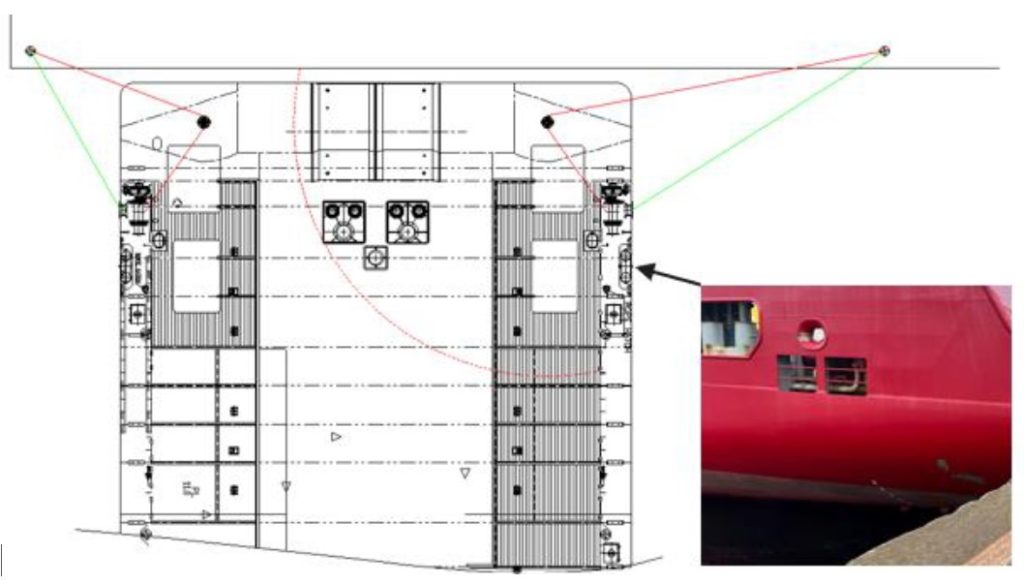
  • When arrangement on quayside allows, route the mooring line directly to chock on hull side (green line) instead of over guide roller on the stern (red line) to avoid line of fire/snapback zone on working deck. (see illustration).
Safety Alert : Left Hand Caught in Between Mud Pump Liner &. Piston

Title: Left Hand Caught in Between Mud Pump Liner &. Piston.

Location: Jack Up Drilling Rig.

Loss/ Outcome: Hand Injury.

BRIEF OF INCIDENT

Drilling of 12 ¼” hole section was in progress and both the mud pumps were running. Suddenly mud leak from middle piston was observed. Operation was suspended to replace the liner & piston. Drilling crew replaced the liner and subsequently installation of piston assembly was taken up. Injured Person (IP) was holding the piston assembly for alignment with liner, while other three crew members were manually rotating the crank shaft to push the piston cup inside the liner. During this activity, the hand glove of the IP got stuck between piston cup and liner inner surface. The crew, who were rotating the crankshaft could not stop crank shaft immediately and piston continued to move inside the liner, which resulted major injury to left hand of the IP. Crew stopped the movement of the crankshaft and removed the left hand of the IP and shifted him to the rig dispensary. After providing first aid, IP was finally shifted to base for treatment.

OBSERVATIONS/ SHORTCOMINGS

  • Job Safety Analysis was not carried out before the commencement of the liner-piston replacement job. The risk involved and their role to mitigate the risks was not explained to young officers.
  • Among the available drilling crew members, only shift In-charge (IP) had some first-hand experience of replacement of mud pump liner and piston and other crew members only assisted during such jobs in the past.
  • Shift In-charge (IP) himself was leading the team for this job and he deputed two crew members for the rig floor operation as drilling string was in open hole.
  • While aligning the piston assembly with liner, the IP seemed to be incorrectly holding the piston rod very close to the piston cup.
  • Due to limited man power, there was no independent supervision during the job.

REASONS OF FAILURE/ ROOT CAUSE

  • Due to improper positioning of hand of IP on piston assembly for alignment, left hand of IP got caught between piston and liner.
  • Adequate supervision was not available for this job due to shortage of manpower.
  • Lack of experienced manpower for this job due to disruption of shift schedule caused by ongoing pandemic.
  • Provided for information purpose only. This information should be evaluated to determine if it is applicable in your operations, to avoid recurrence of such incidents.

RECOMMENDATIONS

  • Job Safety Analysis should be carried out in more focused manner. More so over, when new/ inexperienced crew members are in team or non regular crew are performing the job. Crew members may be unaware about the hazard associated with the operation they were carrying out.
  • The crew should not be dependent on few individuals for such regular maintenance jobs. Other crew members should be trained under supervision of experienced crew to gain first-hand experience for such regular maintenance jobs.
  • All Activities should be supervised by competent person(s) 

Safety Alert (06.12.2020) : Rigging failure – clump weight dropped to seabed

 What happened?

A clump weight used for anchoring a weather buoy was being deployed over the sea when the long link chain attached to the vessel crane hook failed resulting in the clump weight dropping to the seabed.

The 2.6t clump weight was the anchor component of a mooring arrangement for the weather buoy.  The load was rigged using a supplied mooring arrangement, which followed the manufacturer’s drawing in the weather buoy manual. Instead of a 450kg weight it was decided to use the 2.6 tonne clump weight already available and which had been shipped to the location for deployment.  A service specialist prepared a deployment procedure which was discussed with those involved in the task.  Shortly after the load was submerged in the sea the chain link attached to the quick-release mechanism snapped, and the load dropped to the seabed in an uncontrolled manner.

The findings revealed:

1) The rigging failed because a larger clump weight (2.6t) was selected than the design allowed for (450kg). This decision was based on previous experience where the standard weight (450kg) did not adequately secure the weather buoy;

2) The design and installation procedure were not revised to accommodate the heavier clump weight;

3) The chain selected was not suitable for lifting.  Declaration of conformity by the chain manufacturer confirmed that the working load limit was “2.5 Tonne Not for lifting”.

Actions

1) All planned deviations from procedures should be subject to a formal Management of Change (MoC) process, the risk of the change adequately assessed and the change authorized by a competent person before the work proceeds;

2) Reinforce to the riggers and personnel involved in lifting operations:

3) The need for thorough lift planning, and,

4) That they make a thorough check that lift rigging is certified, fit for purpose and appropriate for that specific lift.

Safety Alert (02.12.2020) - Accident Due to Failure of Monorail Hoist

Title: Accident Due to Failure of Monorail Hoist

Location: Offshore Platform

Loss/ Outcome: Major Injury

INCIDENT

An incident took place where a team of eight persons were carrying out Engine replacement job. New PGC Engine, weighing approximately 1.63 Tons, was being lifted with the help of Monorail hoist to shift it to engine placing area. After lifting the engine to approximately two meters height, Monorail hoisting mechanism got stuck. While trying to release, its mechanism failed and engine came down on to the floor and left leg of Executive Engineer (Mechanical) was caught in between the engine and floor, resulting in the severe injury. He was shifted immediately to infirmary on stretcher. On board medical officer examined and gave first aid. Later he was sent to base for further treatment.

Fig. Monorail Hoist (View from Upper Platform Deck)

OBSERVATIONS

  • Observed illumination in the area was poor for carrying out such major operations after sunset.
  • Housekeeping of the area was very poor and a lot of accumulation of lube oil was observed on the floor in and around the PGC area.

ROOT CAUSE

  • Operating mechanism failure of the Monorail Hoist, resulted in Engine coming down to floor.

RECOMMENDATIONS

1) Load testing of all the Lifting equipment is to be done as per their schedule and record of certificates/ details of the testing/ repairs done, to be maintained, for reference according to OISD-RP-126 clause 8 which states

  • To ensure safe utilization of lifting tools & tackles, periodic inspection and testing as per applicable statutory rules and regulations applicable shall be carried out.
  • Each lifting tool & tackle shall have unique identification and shall display the safe working load, testing date and next due date for testing.
  • Records shall be maintained for verification

2) Illumination survey of the PGC area to be carried out and action to be taken accordingly, to improve the same for safe working according to OISD-RP-149, clause:9

3) Proper Housekeeping of the complete area to be carried out to make the area a safe working place.

4) Before taking up such major work, it should be ensured that people attending the job are in sound healthand stress free .